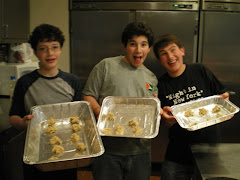
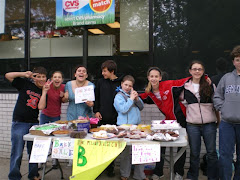
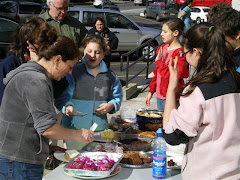
A decade before the genocidal war in Darfur that our tzedakah project revolved around, there was another terrible genocide in Africa, this one in Rwanda.
Today, Rwanda is still stuggling to recover from this tragic experience.
Israelis from Keren Kayemet L'Yisrael (the Jewish National Fund) have created a youth village to help teach young Rwandans agriculture techniques. In the video you can hear the Israelis speaking Hebrew and talking about tikkun olam, mending the world. Check it out:
http://blogs.jta.org/philanthropy/2008/07/15/200/teach-a-man-to-farm/
Thursday, July 17, 2008

Wednesday, June 11, 2008
L'hitraot
First of all, thanks to all of you who participated in this project throughout the year. I hope it enabled people to think about many new topics in different ways.
Secondly, while I was busy getting all choked up at the graduation ceremony, I forgot one of my main messages, which was that I hope you continue to think critically about what others say and also challenge your own viewpoints. Don't get stuck behind any one particular point of view, but be open to other possibilities. Like Rabbi Schuck said, it's important to keep learning and growing, and not always think the same way about things as we did in the past. Ideally, we will all look back at some of what we wrote and say, 'Wow, I can't believe I felt that way; I really see things differently now,' and that certainly goes for me as well. So, keep on learning and carrying on the "mackloket l'shem shamayim," arguments for the sake of heaven.
I have enjoyed learning with you, both in the classroom and in cyber-space!
Have a wonderful kayitz. L'hitraot!
Secondly, while I was busy getting all choked up at the graduation ceremony, I forgot one of my main messages, which was that I hope you continue to think critically about what others say and also challenge your own viewpoints. Don't get stuck behind any one particular point of view, but be open to other possibilities. Like Rabbi Schuck said, it's important to keep learning and growing, and not always think the same way about things as we did in the past. Ideally, we will all look back at some of what we wrote and say, 'Wow, I can't believe I felt that way; I really see things differently now,' and that certainly goes for me as well. So, keep on learning and carrying on the "mackloket l'shem shamayim," arguments for the sake of heaven.
I have enjoyed learning with you, both in the classroom and in cyber-space!
Have a wonderful kayitz. L'hitraot!
Saturday, May 31, 2008
To Fast or Not to Fast
This week we discussed Tisha B'Av (the 9th of Av), which is coming up over the summer. On Tisha B'Av we commemorate the destruction of the Temple in Jerusalem (both actually, first by the Babylonians and then for a final time by the Romans), followed by the exile of the Jews from their homeland.
Because it was such a tragic date in Jewish history, we have begun to commemorate other tragic events on that day as well, such as the capture of Beitar during the failed Bar-Kochba revolt and expulsions of the Jews from England in 1290 and Spain in 1492.
Tisha B'Av was decreed by the Rabbis of the Talmud to be a day of fasting (also, we recite services without a tune and sit on the ground). I do fast, but I have always been a bit ambivalent about it. I could understand having a memorial service or saying special prayers, but fasting seems a bit harsh (especially in August!) Moreover, the Jewish people can now call the State of Israel home again. Because of this, there are many Conservative rabbis who believe that you only need to fast until mincha (instead of nightfall). On the other hand, others feel this is not adequate. After all, maybe it's necessary to keep the memory of this catostrophic event alive through something as powerful as fasting. What do you think of this half-day practice?
Because it was such a tragic date in Jewish history, we have begun to commemorate other tragic events on that day as well, such as the capture of Beitar during the failed Bar-Kochba revolt and expulsions of the Jews from England in 1290 and Spain in 1492.
Tisha B'Av was decreed by the Rabbis of the Talmud to be a day of fasting (also, we recite services without a tune and sit on the ground). I do fast, but I have always been a bit ambivalent about it. I could understand having a memorial service or saying special prayers, but fasting seems a bit harsh (especially in August!) Moreover, the Jewish people can now call the State of Israel home again. Because of this, there are many Conservative rabbis who believe that you only need to fast until mincha (instead of nightfall). On the other hand, others feel this is not adequate. After all, maybe it's necessary to keep the memory of this catostrophic event alive through something as powerful as fasting. What do you think of this half-day practice?
Friday, May 16, 2008
Sh'mita Controversy in Israel
Our guest this week discussed the laws of "sh'mita" in the parasha. Sh'mita is the sabbatical year (every seventh year), when the land is supposed to lay fallow and not be worked or farmed. It also involves letting people get out of their loans if they are too far in debt.
In modern times, rabbis have found loopholes in order to let poor farmers continue to work on the shmita year; for example, they would "sell" the farmland to non-Jews for the year (sort of like selling our chametz on Pesach) so they could still work the land and keep their livelihood.
This past year there has been a big controversy in Israel, because the Chief Rabbinate has ruled that the loopholes no longer apply and that the original law from the Torah should be kept. This ruling has caused many problems, especially for small farmers who don't want to lose business.
Where do you stand on this debate with the Chief Rabbinate?
Check out the story NPR did on the controversy. You can listen, or read the transcript of the radio interview.
In modern times, rabbis have found loopholes in order to let poor farmers continue to work on the shmita year; for example, they would "sell" the farmland to non-Jews for the year (sort of like selling our chametz on Pesach) so they could still work the land and keep their livelihood.
This past year there has been a big controversy in Israel, because the Chief Rabbinate has ruled that the loopholes no longer apply and that the original law from the Torah should be kept. This ruling has caused many problems, especially for small farmers who don't want to lose business.
Where do you stand on this debate with the Chief Rabbinate?
Check out the story NPR did on the controversy. You can listen, or read the transcript of the radio interview.
Monday, May 12, 2008
Remembering
This past month has been filled with memories, many of them negative or painful: before Purim we read the Torah portion that instructs us to remember Amalek, the tribe that sought to destroy the Israelites and from which Haman descended; at Pesach we saw ourselves as having come out from slavery; at the end of Pesach we recited the Yizkor prayer in shul in memory of family members who have passed away; on Yom Hashoah we remembered those who perished in the Holocaust; and on Yom Hazikaron we memorialized Israel's fallen soldiers and the victims of terror attacks.
That is a lot to remember! Especially due to the nature of these particular memories, it can be an emotionally draining period. Does this period bring you down? Or give you resolve? Do you personally find benefits - or downsides - to all of this collective memory? How do all of these memories affect you? Your Jewish identity?
That is a lot to remember! Especially due to the nature of these particular memories, it can be an emotionally draining period. Does this period bring you down? Or give you resolve? Do you personally find benefits - or downsides - to all of this collective memory? How do all of these memories affect you? Your Jewish identity?
Friday, April 25, 2008
Sympathy for our Enemies?
At the model seder we practiced spilling out ten drops of wine from our glass, which we do at our seders to indicate that even though the Egyptians were our enemies, they were still human beings, created by God. I even noticed that one student became upset when another student began to suck the juice off his finger, because he felt strongly that the point was for us not to gain any joy or benefit from it. What do you think is an appropriate way for us as Jews to react to the death of an enemy? If someone like Hassan Nasrallah, leader of the Lebonese terrorist group Hezbollah, were to die tomorrow, how should we react?
Sunday, March 30, 2008
Getting Angry at God
In class, we conducted "faith interviews," and one of the questions was, "If God is good, how can God permit evil in the world?" Lots of views were presented during our discussion. In shul, the rabbi gave a powerful sermon that was directly connected to this discussion. He encouraged us to get angry at God when bad things happen, and not to dismiss bad things as having no connection to God. He suggested that this would ultimately help us develop a closer relationship with God in our lives. When do you get angry at God? Does expressing this anger help you feel close to God, either at that time or later on?
Thursday, March 13, 2008
Is Kavanah Key?
The sofer told us that in order to write a Torah scroll properly, you need to have the proper intention/concentration ("kavanah"). Judaism also says that when we pray, we are supposed to have kavanah. But we are supposed to pray three times a day, and we don't always feel in the mood. Is it more important to pray anyway, or is it better to wait to pray until you really have full kavanah? When do you find you have kavanah, and when not?
Tuesday, March 11, 2008
Morality at the Movie Theater
I heard something this weekend that reminded me of the "moral scenarios" from our Shabbat dinner. My film-obsessed friend went to the movies over the weekend, but after her movie ended she decided to sneak into another theater in the builiding to watch another one. But - she got caught. The people made her leave, but they were also very rude and obnoxious, and she felt like they treated her inappropriately. She decided to file a complaint with the manager about how they treated her, and the manager ended up giving her more free tickets!
What would you do - give them away, throw them out, or use them?
What would you do - give them away, throw them out, or use them?
Sunday, March 9, 2008
Looking Ahead
I have been practicing haftarah with some students (all sound great!) and I know that everyone is excited about their bat/bar mitzvahs. Some students have said they will continue with the Hebrew high school program after their b'nei mitzvah, while others will not be able to. Whether you will continue at PJC or not, what area of Jewish learning would you like to continue as 'Jewish adults', either in a formal setting or on your own, once Hebrew School is officially over?
Thursday, February 28, 2008
It's a Miracle (?)
People had several ideas about why God's name is not mentioned in the entire Megillah. One opinion was that the miracle of the story was brought about by the actions of people like Mordechai and Esther, not necessarily God. Do miracles come from God, people, or both?
Purim - Hiding our Identities (or not)
When we reviewed the Purim story (in Megillat Esther) we discussed how Esther hid her Jewish identity when she first entered the palace. She only revealed it later when Mordechai asked her to intervene on behalf of the Jews who were in harm's way. (By the way, the name "Esther" comes from the same shoresh/root as the word "to hide." Note that we also "hide" behind masks and costumes on Purim).
Most of us act like Esther at some point. When do you hide your identity, and when do you display it proudly?
Most of us act like Esther at some point. When do you hide your identity, and when do you display it proudly?
Tuesday, February 26, 2008
Jews in sports...and politics
Shahar Peer (the women's tennis star) is one of the Israeli athletes who came up in our discussion of Jewish sports organizations (e.g. Beitar, the 1987 soccer champions!) We all like to cheer for Jewish and Israeli athletes. I wondered if that same feeling of pride extended to political candidates.
Are you more likely to support a candidate for office if he/she is Jewish or supports Israel?
Should this be a major factor in how we (or our families) vote?
Are you more likely to support a candidate for office if he/she is Jewish or supports Israel?
Should this be a major factor in how we (or our families) vote?
Thursday, February 7, 2008
At home or a guest?
We have begun discussing Zionism, the movement to establish a Jewish state in the land of Israel, the Jews' historic homeland. We read how Leon Pinsker and others felt that Jews in Europe were seen as "guests" in someone else's home. As a wave of nationalism swept through European countries, many Jews began to develop a sense of Jewish nationalism. They wanted a country to call their own, where they would be at home, not guests.
Do you ever feel like a guest in this country? What about this country makes you feel at home?
Considering the vast freedoms that Jews have as citizens in this country, is having a Jewish state still necessary?
Do you ever feel like a guest in this country? What about this country makes you feel at home?
Considering the vast freedoms that Jews have as citizens in this country, is having a Jewish state still necessary?
Tuesday, February 5, 2008
Welcome to PJC Kitah Zayin!
B'ruchim Habaim (welcome!) This web log is for students in Kitah Zayin at the PJC Learning Center to respond to questions about Torah and Jewish learning.
When responding to posts, please use language and writing that displays kavod (respect) for the subject matter and for your classmates' ideas.
Be thoughtful, creative, honest...and enjoy!
When responding to posts, please use language and writing that displays kavod (respect) for the subject matter and for your classmates' ideas.
Be thoughtful, creative, honest...and enjoy!
Subscribe to:
Comments (Atom)